
The Perfect Storm
When warnings are everywhere, and still no one moves

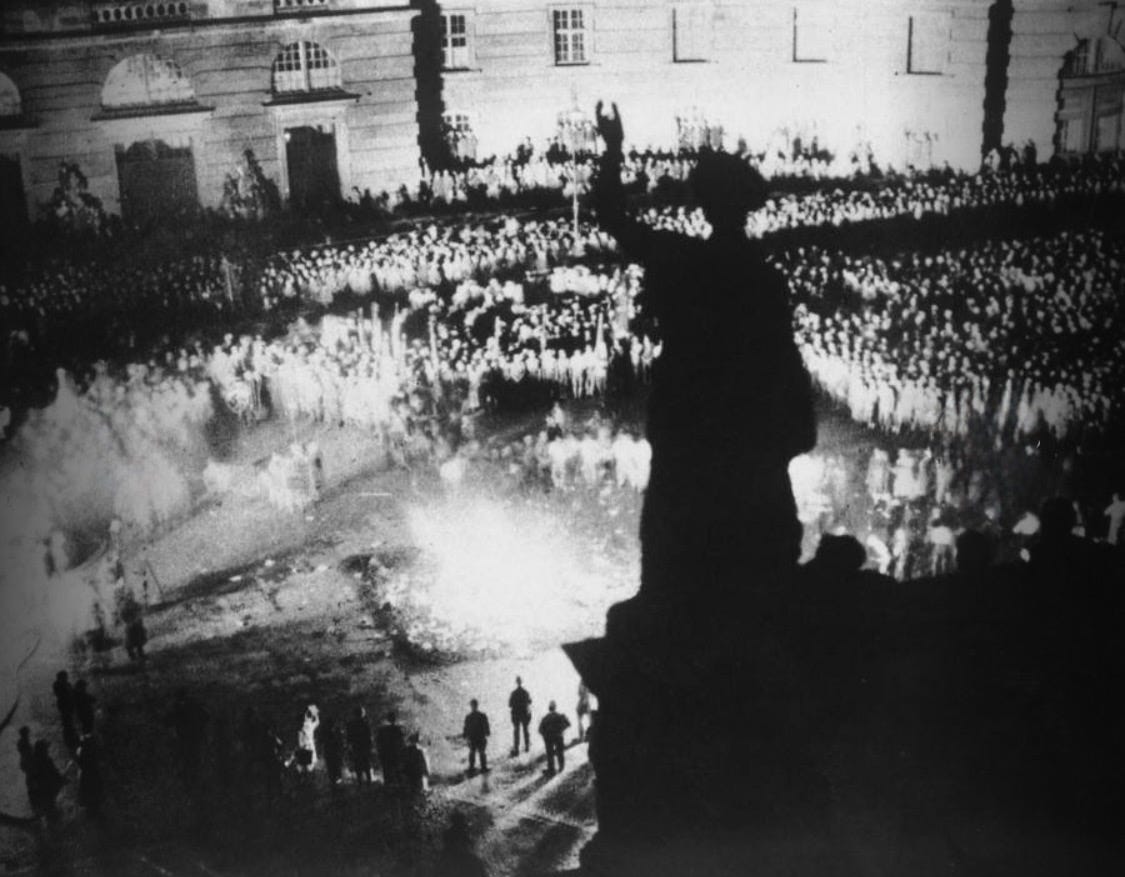
Munich, November 1923, smelled of damp wool and beer. The streets were slick with rain, the kind that seeps into cuffs and makes everything feel a degree more irritable. Inside the Bürgerbräukeller, a low-ceilinged beer hall thick with smoke and impatience, a man with a clipped mustache climbed onto a chair and began to shout.
He was not yet famous. He was not yet inevitable. He was loud, theatrical, angry, and persuasive in a way that made people lean forward without realizing they were doing it. His name was Adolf Hitler, and on that wet November night he attempted, clumsily and prematurely, to overthrow the German government.
The coup failed. The rain washed the streets clean by morning. Munich reopened its cafés. Children went to school. And the German courts, faced with what should have been an unmistakable warning, responded with something closer to indulgence. Hitler was sentenced lightly. Prison became a writing retreat. The failed rebellion became rehearsal.
There were people watching this closely.
Police reports from the early 1920s described Nazi rallies as unusually violent, disciplined, and obsessive. Judges noted the movement’s contempt for the republic it claimed to participate in. Journalists wrote of brownshirted men who lingered outside meetings, memorizing faces, blocking exits, intimidating opponents.
The brownshirts were not simply thugs. They were organized, uniformed, and methodical. They kept lists. They photographed opposition rallies. They learned where people worked, where their children went to school. Violence was secondary to the atmosphere of surveillance, the understanding that you had been seen and noted. This was intimidation as infrastructure.
And always, Hitler’s central narrative was a lie about theft—that Germany had won the war but been betrayed from within, that victory had been stolen by traitors and Jews. The Big Lie, repeated until it became the foundation of everything that followed.
This was not rowdy politics. This was a movement practicing control.
Berlin, at the time, was still electric with culture. Trams rattled past bookstores and cabarets. Intellectuals argued late into the night over cigarettes and black coffee. And among them were men and women who understood that something was going wrong beneath the surface.
Albert Einstein, walking the streets of Berlin in the early 1920s, watched nationalist fervor harden into doctrine. He warned publicly that antisemitism and militant nationalism were not rhetorical excesses but early symptoms. A scientist recognizes a reaction once it has begun.
In Jewish neighborhoods across Berlin and Munich, the warnings were not theoretical. Shopkeepers noticed the boys who stood across the street, watching. Professors read the editorial cartoons and recognized the medieval accusations dressed in modern language. Rabbis counseled families on whether to stay or leave, knowing that either choice might be wrong. By 1933, more than 37,000 German Jews had already emigrated—not because they were cowards, but because they understood the difference between rhetoric and intent. Those who stayed believed Germany was still Germany. They were wrong about the timeline, though not about what was coming.
So did the writers. Thomas Mann, tall, formal, possessed of a novelist’s sensitivity to moral weather, stood before audiences and warned that Nazism was not simply another political option but a collapse of values. He spoke of a Germany losing its soul. By 1933, Mann was gone, watching his country from exile, the Alps between him and the crowd that had stopped listening.
In cafés and lecture halls, a young philosopher named Hannah Arendt was already noticing something else: the loneliness. The way mass movements offered belonging before they offered violence. The way grievance could be turned into purpose. She would later give this phenomenon a name. For now, she simply fled. Germany, by then, had become dangerous to clarity.
Inside the Reichstag, Social Democrats rose one after another to warn that the Nazis were not colleagues but saboteurs. They were shouted down. Called hysterical. Accused of exaggeration. The Communists warned too, though fatally divided from potential allies. The left argued while the right marched in step.
The labor unions understood as well. They had seen how the Nazis broke strikes, how brownshirts appeared at factory gates with lists and clubs. Union leaders warned their members that this was not a negotiation between capital and labor—this was the elimination of the very idea that workers could organize. They were right. On May 2, 1933, union halls across Germany were raided simultaneously, leaders arrested, assets seized. The entire structure of organized labor disappeared in an afternoon.
Outside Germany, the weather was different, but the danger was still visible.
In London, fog rolled along the Thames as politicians debated peace and budgets and the unbearable memory of the last war. Winston Churchill, sidelined and restless, watched Germany rearm and warned that Hitler’s speeches were not bombast but instruction. He was mocked as a relic, a warmonger, a man haunted by yesterday’s fears. Appeasement was easier to sell than preparation.
Across the Atlantic, Dorothy Thompson sat at her desk and typed. She had interviewed Hitler once and dismissed him as insignificant. She revised her judgment quickly. By the early 1930s, Thompson was writing with clarity and urgency that Germany had fallen into dictatorship, that fascism was not a mood but a system. In 1934, the Nazis expelled her from the country. She boarded a train carrying her notebooks and her warnings. America read her columns. America did nothing.
This is the part that feels most unsettling in retrospect: nothing stopped. Not right away.
Elections continued. Shops opened each morning. Neighbors nodded to one another on stairwells. People argued about prices, about manners, about whether things would calm down now that the extremists had responsibilities. Respectable people convinced themselves that responsibility would moderate the radicals. That governing was different from campaigning. That the system itself would sand down the rough edges. They confused exhaustion with stability.
Authoritarianism did not arrive with sirens. It arrived with forms, regulations, committees, and reassurance.
Within months of taking power, the civil service was purged of Jews and political opponents. Military officers who expressed concern were retired or reassigned. The bureaucracy that might have resisted became the machinery that implemented. And always, there was the promise to use state power against enemies—real or invented. Lists of Communists, of Jews, of undesirables. Threats of investigation, prosecution, deportation. The law itself became a weapon, wielded selectively, until legality meant only what the regime said it meant.
Institutions do not defend themselves. They require people willing to be personally inconvenient.
History, it turns out, does not announce itself. It waits to see who is paying attention.
The people who warned first were not prophets. They were observers. They noticed tone. Pattern. Escalation. They recognized when politics stopped being disagreement and started being elimination.
They were dismissed because they were inconvenient. Because they disrupted comfort. Because listening would have required action.
They told you then. They told you again. They are telling you now.
And the question history keeps asking is the same one it always asks at this point in the story: when did you know?
Most people do not embrace authoritarianism. They wait it out. They hope it will burn itself down without requiring their involvement. They confuse endurance with resistance. By the time waiting becomes impossible, participation has already been assigned.
The warnings were there all along.
Years from now, someone will write about this period the way we now write about Munich and Berlin and London and New York in the 1930s. They will describe the weather. The headlines. The conversations that seemed harmless at the time.
And they will describe, in careful detail, exactly who was warned, and when, and how clearly.
Note:
This essay began as most warnings do: with a feeling in the chest that something familiar was happening again. I have been voting since Nixon was elected in 1972. I have watched American politics shift and recalibrate and occasionally lose its mind for decades. But I have never before felt the particular quality of silence that falls when people who should know better decide that alarm is unseemly.
History is not subtle. It repeats itself because we are not nearly as original as we think we are, and because the people who warn us sound hysterical right up until the moment they sound inevitable. This piece is about the first people who saw fascism coming in the 1920s and 1930s—not because they were prophets, but because they were paying attention. It is also, though I have tried to write it with enough restraint that you must make the connections yourself, about now.
I have written this the way I think important warnings should be written: clearly, literarily, without histrionics, and with enough respect for the reader that I do not underline every metaphor. If you finish this essay and feel nothing, I have failed. If you finish it and feel something but do nothing, history will note that too.
I want your thoughts. Do you see what I see?
—Gloria
References and Sources
Primary Historical Events
The Beer Hall Putsch (Munich, November 1923)
Kershaw, Ian. Hitler: 1889-1936: Hubris. W.W. Norton & Company, 1998.
Evans, Richard J. The Coming of the Third Reich. Penguin Press, 2004.
Shirer, William L. The Rise and Fall of the Third Reich: A History of Nazi Germany. Simon & Schuster, 1960.
Hitler’s Trial and Imprisonment
Gordon, Harold J. Hitler and the Beer Hall Putsch. Princeton University Press, 1972.
Weber, Thomas. Becoming Hitler: The Making of a Nazi. Basic Books, 2017.
The Brownshirts (SA - Sturmabteilung)
Organization and Tactics
Longerich, Peter. Hitler’s Paramilitary Politics: The SA and the Nazi Seizure of Power. Cambridge University Press, 2020.
Gallo, Max. The Night of Long Knives. Harper & Row, 1972.
Merkl, Peter H. The Making of a Stormtrooper. Princeton University Press, 1980.
Violence and Intimidation
Fischer, Conan. Stormtroopers: A Social, Economic and Ideological Analysis, 1929-35. George Allen & Unwin, 1983.
Bessel, Richard. Political Violence and the Rise of Nazism: The Storm Troopers in Eastern Germany, 1925-1934. Yale University Press, 1984.
The “Big Lie” and Propaganda
The Stab-in-the-Back Myth (Dolchstoßlegende)
Barth, Boris. Dolchstoßlegenden und politische Desintegration: Das Trauma der deutschen Niederlage im Ersten Weltkrieg 1914-1933. Droste Verlag, 2003.
Chickering, Roger. Imperial Germany and the Great War, 1914-1918. Cambridge University Press, 2004.
Nazi Propaganda Techniques
Bytwerk, Randall L. Bending Spines: The Propagandas of Nazi Germany and the German Democratic Republic. Michigan State University Press, 2004.
Welch, David. The Third Reich: Politics and Propaganda. Routledge, 2002.
Albert Einstein
Einstein’s Warnings and Emigration
Isaacson, Walter. Einstein: His Life and Universe. Simon & Schuster, 2007.
Rowe, David E., and Robert Schulmann, eds. Einstein on Politics: His Private Thoughts and Public Stands on Nationalism, Zionism, War, Peace, and the Bomb. Princeton University Press, 2007.
Sayen, Jamie. Einstein in America: The Scientist’s Conscience in the Age of Hitler and Hiroshima. Crown Publishers, 1985.
Thomas Mann
Mann’s Opposition to Nazism
Kurzke, Hermann. Thomas Mann: Life as a Work of Art. Princeton University Press, 2002.
Mann, Thomas. “An Appeal to Reason” (speech, 1930). In Order of the Day: Political Essays and Speeches of Two Decades. Alfred A. Knopf, 1942.
Harpprecht, Klaus. Thomas Mann: Eine Biographie. Rowohlt, 1995.
Hannah Arendt
Early Observations and Escape from Germany
Young-Bruehl, Elisabeth. Hannah Arendt: For Love of the World. Yale University Press, 1982.
Arendt, Hannah. The Origins of Totalitarianism. Harcourt, Brace and Company, 1951.
Benhabib, Seyla. The Reluctant Modernism of Hannah Arendt. Sage Publications, 1996.
Jewish Emigration from Germany
1933 Emigration Statistics
Strauss, Herbert A. “Jewish Emigration from Germany: Nazi Policies and Jewish Responses (I).” Leo Baeck Institute Year Book 25, no. 1 (1980): 313-361.
Barkai, Avraham. From Boycott to Annihilation: The Economic Struggle of German Jews, 1933-1943. University Press of New England, 1989.
Kaplan, Marion A. Between Dignity and Despair: Jewish Life in Nazi Germany. Oxford University Press, 1998.
Jewish Community Awareness and Response
Friedländer, Saul. Nazi Germany and the Jews, Volume 1: The Years of Persecution, 1933-1939. HarperCollins, 1997.
Mosse, Werner E., ed. German-Jewish History in Modern Times, Volume 4: Renewal and Destruction, 1918-1945. Columbia University Press, 1998.
Political Opposition in the Reichstag
Social Democrats and Communists
Evans, Richard J. The Coming of the Third Reich. Penguin Press, 2004. (Chapter on political opposition)
Winkler, Heinrich August. Germany: The Long Road West, 1933-1990. Oxford University Press, 2007.
Mommsen, Hans. The Rise and Fall of Weimar Democracy. University of North Carolina Press, 1996.
Labor Unions
Destruction of German Labor Movement (May 2, 1933)
Mason, Timothy W. Social Policy in the Third Reich: The Working Class and the ‘National Community’. Berg Publishers, 1993.
Smaldone, William. Rudolf Hilferding: The Tragedy of a German Social Democrat. Northern Illinois University Press, 1998.
Evans, Richard J. The Third Reich in Power. Penguin Press, 2005.
Winston Churchill
Churchill’s Warnings About Hitler
Churchill, Winston S. The Gathering Storm (The Second World War, Volume I). Houghton Mifflin, 1948.
Gilbert, Martin. Churchill and the Jews. Henry Holt and Company, 2007.
Manchester, William. The Last Lion: Winston Spencer Churchill: Alone, 1932-1940. Little, Brown and Company, 1988.
Dorothy Thompson
Thompson’s Journalism and Expulsion from Germany
Kurth, Peter. American Cassandra: The Life of Dorothy Thompson. Little, Brown and Company, 1990.
Sanders, Marion K. Dorothy Thompson: A Legend in Her Time. Houghton Mifflin, 1973.
Thompson, Dorothy. I Saw Hitler! Farrar & Rinehart, 1932.
The Normalization Period and “Responsibilty Will Moderate Them”
Conservative Collaboration and Miscalculation
Turner, Henry Ashby. German Big Business and the Rise of Hitler. Oxford University Press, 1985.
Hett, Benjamin Carter. The Death of Democracy: Hitler’s Rise to Power and the Downfall of the Weimar Republic. Henry Holt and Company, 2018.
Patch, William L. Heinrich Brüning and the Dissolution of the Weimar Republic. Cambridge University Press, 1998.
Civil Service Purges and Gleichschaltung
Law for the Restoration of the Professional Civil Service (April 7, 1933)
Caplan, Jane. Government Without Administration: State and Civil Service in Weimar and Nazi Germany. Clarendon Press, 1988.
Peukert, Detlev J.K. Inside Nazi Germany: Conformity, Opposition, and Racism in Everyday Life. Yale University Press, 1987.
Coordination of State Institutions
Broszat, Martin. The Hitler State: The Foundation and Development of the Internal Structure of the Third Reich. Longman, 1981.
Allen, William Sheridan. The Nazi Seizure of Power: The Experience of a Single German Town, 1922-1945. Franklin Watts, 1984.
General Historical Context
Weimar Republic and Rise of Nazism
Gay, Peter. Weimar Culture: The Outsider as Insider. W.W. Norton & Company, 2001.
Peukert, Detlev J.K. The Weimar Republic: The Crisis of Classical Modernity. Hill and Wang, 1992.
Fritzsche, Peter. Germans into Nazis. Harvard University Press, 1998.
How Democracies Fall
Levitsky, Steven, and Daniel Ziblatt. How Democracies Die. Crown, 2018.
Snyder, Timothy. On Tyranny: Twenty Lessons from the Twentieth Century. Tim Duggan Books, 2017.
Albright, Madeleine. Fascism: A Warning. Harper, 2018.
Archival and Documentary Sources
United States Holocaust Memorial Museum. “The Nazi Rise to Power.” Holocaust Encyclopedia. https://encyclopedia.ushmm.org/
German Historical Institute. Records and reports on Nazi Party activities, 1920-1933.
Leo Baeck Institute. Collections on German-Jewish history and emigration.
Note on Sources:
This essay draws on both primary historical documents (speeches, newspaper accounts, police reports, emigration records) and secondary scholarly works by historians specializing in the Weimar Republic, Nazi Germany, and the individuals mentioned. All factual claims—including the Beer Hall Putsch, Hitler’s lenient sentence, the 37,000 Jewish emigrants by 1933, the May 2, 1933 union raids, and the civil service purges—are documented in multiple authoritative sources. The characterizations of individuals like Einstein, Mann, Arendt, Churchill, and Thompson are based on their own writings, biographies by respected scholars, and historical consensus.
The only positive thing about this time in history to me is I finally understand how Hitler was able to do what he did. I never could comprehend how the people didn’t stop him. It made no sense. Now I do.
People are treating evil as if it’s something that will go away rather than expand. They’ve turned into sitting ducks.
If we repeat history, we will be even worse than ignorers of evil. We will be ignorers of history plus evil. And that was some story we are inviting back. Our ancestors will find our letting this happen deplorable.
I applaud you for this piece.
The taboo on Hitler comparisons is over. I welcome them to inspire action.
I live all the way away in Aotearoa (New Zealand) and my Grandfather a life long Communist in a very conservative country gathered his family together after reading the Powell Memorandum in the mid 70’s (Yes it took a few years to be seen all the way across the Pacific) and told us to learn how to grow food, to be vigilant about extremes in every part of government and to understand that another World War was only a matter of time because money is seductive but power is the ultimate vice. My grandfather is now long gone, but living in a country that looks to the US it has been apparent for a very long time that my grandfather was right to warn us that the greedy and power hungry were busy creating their space to act. I just didn’t believe that so many could be so complicit in the process.