
The Surrender
Chapter Five — 430 Feet: One Bullet. One Rooftop. Nobody Was Watching.

Read from the beginning: Chapter One: The Place | Chapter Two: The Morning | Chapter Three: The Bullet | Chapter Four: The Manhunt
———
She saw the photograph on the news.
That is how it ended — not with a SWAT team, not with a helicopter over a rooftop, not with a hundred agents kicking in a door. It ended because a mother in Washington, Utah, looked at a television screen and recognized her son.
Amber Robinson did not call 911. She did not call the FBI tip line that had already received thousands of calls from strangers who thought they recognized the man in the surveillance images — the black shirt, the black hat, the Converse sneakers. She called Tyler. She asked where he was. He told her he was at home. He said he was sick.
She hung up. She looked at the photograph again. She told her husband.
Matt Robinson looked at the image and agreed — that was their son. But it was not only the face that told him. It was the rifle. The weapon that law enforcement had recovered from the woods at the edge of the UVU campus, the Mauser bolt-action they had displayed at the press conference — Matt Robinson believed it matched a rifle he had given his son. His father’s rifle. The family rifle, the one Tyler had asked about, the one with no serial number, the one that wouldn’t trace back to anyone.
I’m worried what my old man would do if I didn’t bring back grandpas rifle … idek if it had a serial number, but it wouldn’t trace to me.
Tyler had written that to Lance Twiggs the day before. His parents did not know about the text. They knew about the rifle.
---
September 11, 2025 — afternoon.
The Robinsons lived in Washington, a small city in the red-rock southwest corner of Utah, twenty minutes from the Arizona border. It is the kind of place where families go to church on Sunday and leave their garage doors open during the week. Six bedrooms. A lawn. A family photo in which everyone smiled. Three sons — Tyler the oldest. The parents owned a granite countertop business and were registered Republicans. Their son had been baptized into the Church of Jesus Christ of Latter-day Saints at a young age. He had been a good student. He had attended Utah State University before dropping out and enrolling in an electrical apprenticeship program. He had moved to Orem. He had started dating his roommate. He had started leaning left.
None of that was unusual for a twenty-two-year-old in Utah.
What was unusual was that their twenty-two-year-old was 240 miles away, in an apartment in Orem, and when his mother called to ask where he was, he lied.
---
Late afternoon.
They called again. Tyler would not engage. He deflected. He avoided their questions. His mother later told investigators that her son had become more political over the past year — more pro-gay and trans rights, she said, further from the household’s politics, further from the family’s church, closer to something she could not name and did not understand. She said it the way mothers say these things when the afterward has arrived and they are trying to account for the before.
But it was Matt who broke through. At some point that afternoon — the charging documents do not specify the exact time — Tyler Robinson spoke to his father on the phone and implied that he was the shooter.
And then he said something else.
He said he couldn’t go to jail. He said he just wanted to end it.
---
Evening.
What the Robinson parents did next is the hinge of this chapter and, depending on how the trial unfolds, possibly the hinge of this case.
They did not call the FBI. They did not call the Orem police. They did not call the Utah County Sheriff’s Office. They called a family friend — a man who had spent a career in law enforcement, a retired detective and former deputy with the Washington County Sheriff’s Office. A man who knew the Robinson family through religious association. A man their son might trust. A man who would know how to keep their boy alive.
The retired detective listened. Then he picked up the phone and called Washington County Sheriff Nate Brooksby.
8:02 p.m.
The call lasted one minute and forty-one seconds.
Brooksby later said he “couldn’t fathom” what was about to come out of the man’s mouth. He said he could tell the man’s voice was shaky, and his first thought was that someone had died.
“I know who Charlie Kirk’s shooter is.”
Brooksby called Utah County Sheriff Mike Smith. Smith was shocked. Brooksby later recalled that after about forty seconds, Smith said, “Wait, what are you talking about?” He repeated himself. Smith asked how credible the information was. Brooksby told him: “I trust this guy that called me with my life.”
The FBI had 11,000 tips and 200 interviews and surveillance images broadcast to every screen in the country, and the answer was coming from a retired detective in a town of 30,000 people in the desert.
A negotiation began. Not with Tyler Robinson — not yet. With his fear. Robinson had told his parents he was afraid of being shot by law enforcement. He was afraid of a SWAT team showing up at his apartment in Orem, or at his parents’ house in Washington. He did not want to die in a hallway. He did not want to die at all, or he did — he had already implied as much — but he did not want to die like that.
The conditions for his surrender would need to be, as the Washington County Sheriff’s Office later described them, “gentle.”
Robinson was having suicidal thoughts and had been en route to a remote area in Washington County. His parents convinced him not to do that and conveyed that they would stand by him and help him surrender peacefully.
---
Shortly before 9:00 p.m.
The retired detective drove to the Robinson home. Tyler was there — at some point that evening, he had made the drive south from Orem to Washington, the same 240-mile route he had driven north the morning before, the same interstate, the same red rock opening up through Washington County, the same exit. He had come home.
His parents got in the car. Tyler got in the car. The retired detective drove.
During the drive, the family friend called the personal cellphone of the Washington County Sheriff’s Office patrol division chief to confirm what was happening — the suspect in the assassination of Charlie Kirk was in a car, headed to the building, and he was going to walk in on his own.
They headed to Hurricane — fifteen miles east on State Route 9, past the lava fields and the strip malls and the fast-food restaurants that blur together in every small southwestern town. The Washington County Sheriff’s Office sits in a low tan building. There is a door marked “Authorized Personnel Only.”
They pulled into the parking lot.
---
Approximately 9:00 p.m.
Robinson walked through that door and into a room where plainclothes detectives were waiting. No uniforms. No tactical gear. No handcuffs. The Washington County Sheriff’s Office had been told to make this gentle, and they did. Brooksby later said the deal was that they would treat it “as delicate and as soft as possible, to make him feel comfortable to where he would show up at my office, and that’s exactly what happened.”
He sat down. On a couch. His parents sat beside him.
He was sitting on a very comfortable couch with a water bottle in his hand, not restrained.
The Salt Lake City FBI field office was notified. Utah County law enforcement was notified. Everyone who had spent thirty-three hours looking for this man was told: he is sitting in a room in Hurricane, Utah. He is not going anywhere.
They waited.
---
Robinson sat in the interview room. His parents sat nearby. The water bottle was in his hand or on the table — the details at this point come from Brooksby’s September 17 press conference, not from a camera feed or a transcript. What is known is that Robinson was described as “cooperative, somber, quiet.” What is known is that he was not restrained. What is known is that the room was a room, not a cell — a room with a couch and a table and a door that no one was going to walk through for hours, because the lead investigators were driving south from Utah County, and Utah County is hours from Hurricane.
Brooksby later said: “Concessions were made to make the surrender happen. He was accused of a horrific crime, but we were treating him very civilly, very humanely. And that’s just part of the job.”
They waited two and a half hours.
---
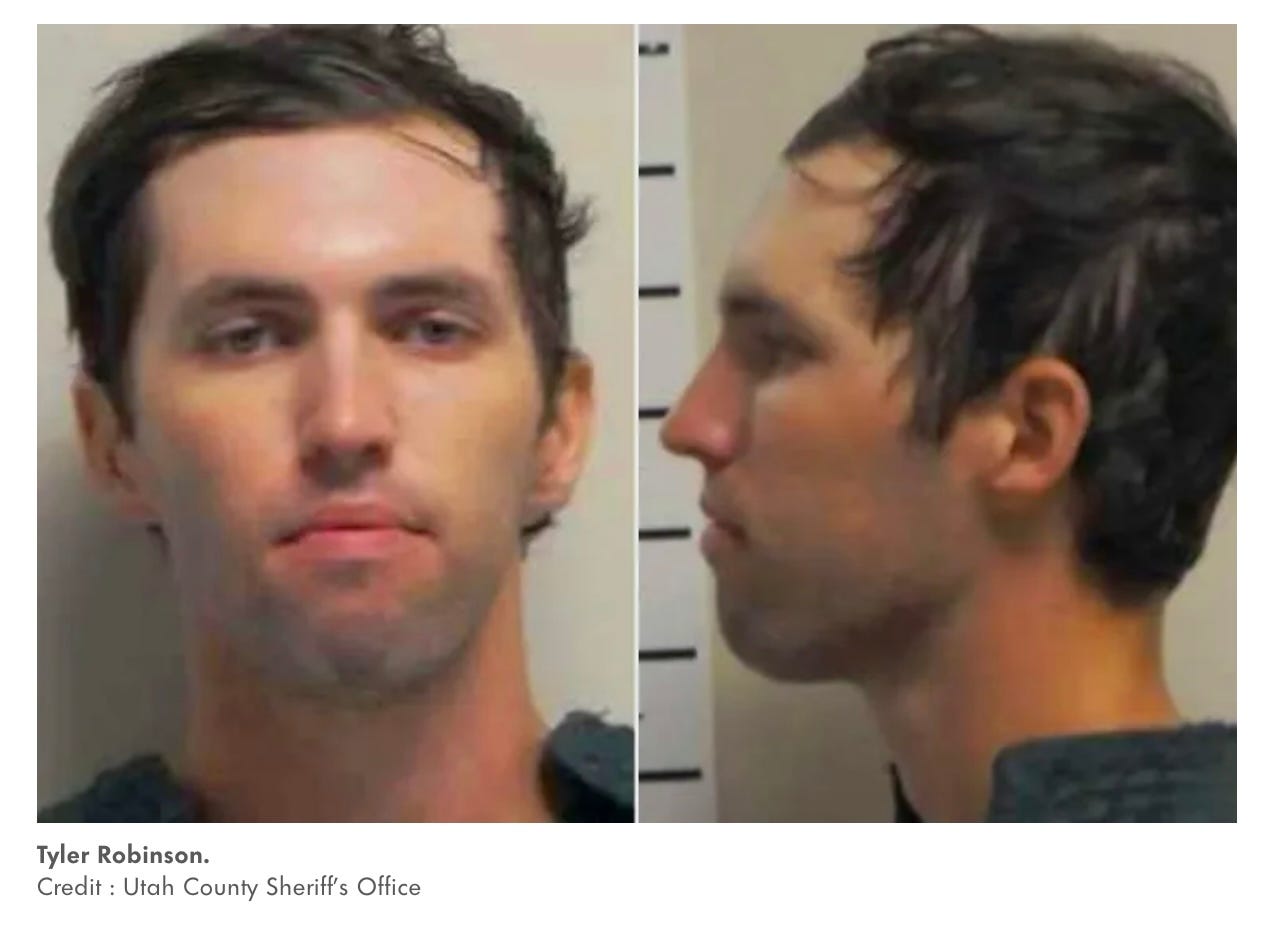
At some point during those hours — before the FBI arrived, before Tyler Robinson was formally taken into custody, before the fingerprinting and the mugshot and the orange jumpsuit and the virtual courtroom appearance and the death penalty announcement — he was just a twenty-two-year-old on a couch.
Not a suspect. Not yet a defendant. Not handcuffed, not booked, not read his rights — just sitting. A bottle of water. His parents somewhere close. The retired detective who had made the call. The officers in plainclothes who had been told to be gentle and were.
Outside that room, the world was still looking for him. Cable news was running the surveillance images on a loop. Kash Patel had already embarrassed himself twice — first with George Zinn, the seventy-one-year-old who had yelled “I shot him, now shoot me” to draw attention from the real gunman, then with a premature post on X announcing a subject was in custody — a post he retracted ninety minutes later. Dan Bongino was in Utah. The FBI had mobilized resources across the Mountain West. President Trump had announced Kirk’s death on Truth Social twelve hours earlier, at 2:40 in the afternoon, and by nightfall had called for the death penalty for whoever did this. More than 7,000 leads had come in. More than 11,000 tips would come in before it was over.
And the man they were all looking for was sitting on a couch in a tan building in Hurricane, drinking water, waiting to be collected.
---
Approximately 2:00 a.m. — September 12, 2025.
Federal and state investigators arrived. Robinson was taken into custody and transported from Hurricane to the Utah County Jail in Spanish Fork — four hours north, back the way he had come, past the red rock, past Cedar City, past the Maverik station where he had filled the tank twenty hours earlier, past the exit for Orem where everything had happened, past the campus where the tent was still standing.
Governor Spencer Cox would announce the arrest later that morning.
“We got him,” Cox said.
Trump would say the same thing on Fox & Friends a few hours after that.
But that is not quite right. They did not get him. A mother saw a photograph. A father recognized a rifle. A family friend made a call that lasted one minute and forty-one seconds. And a twenty-two-year-old who had driven 240 miles to kill a man, and then driven 240 miles home, and then texted his partner, and confessed to his Discord server, and paid for gas with a credit card, and told his father he wanted to die — that twenty-two-year-old got in a car with his parents and drove fifteen miles to a tan building and sat down on a couch and waited.
Thirty-three hours from a rifle crack at 430 feet to a water bottle on a couch in Hurricane.
Nobody dragged him in.
He walked.
---
Brooksby went to the same high school as the man he helped bring in. He said it during the press conference, quietly, almost to himself: “He happened to go to the same high school here in Washington County. So it’s a double shock factor. That one, it happened in Utah, and that the suspect happened to be a homegrown Washington County boy.”
Six months later, Brooksby resigned.
---
Should a suspect’s family be able to negotiate the terms of a surrender?
Does it matter that it worked?
Could you have made the call his parents made?
He sat on a comfortable couch with a water bottle, not restrained. Does that bother you?
They didn’t get him. He walked. Does the distinction matter?
Who in this story are you still thinking about?
What do you want Chapter Six to answer?
Note: 430 Feet is an ongoing investigative series. Every detail in this chapter has been sourced, hyperlinked, and verified against court testimony, law enforcement press conferences, and published reporting. The surrender timeline has been reconstructed from Washington County Sheriff Nate Brooksby’s September 17, 2025 press conference (covered by The Salt Lake Tribune, CBS News, ABC4, and The Daily Herald), statements by Sgt. Lance Alfred to ABC News, Governor Spencer Cox’s September 12 press conference, charging documents filed in Utah’s Fourth District Court, and CNN’s evidence reporting. If any detail in this series is wrong — a name, a time, a fact — tell me in the comments or by email. Corrections will be made publicly and transparently. This story is too important to get wrong. —Gloria
———
Robinson’s defense attorneys are seeking to delay the May 18 preliminary hearing by at least six months, citing more than 600,000 files received in discovery. The next hearing is scheduled for April 17, 2026, to address the defense’s motion to ban cameras from the courtroom.
———
Next: Chapter Six — Robinson.
Dear Gloria,
Chapter Five reads like a held breath that finally releases — and then refuses to let you go. The architecture of it, the way you move from the mother’s face at the television screen all the way to that couch, earns every word.
Tyler’s fear — that he’d be shot walking through a door, that a SWAT team would end him in a hallway — is the thread I want to pull first, because from where I sit, that fear deserves a direct answer.
Since German reunification in 1990, in 35 years, German police have shot and killed 309 people in total.
The vast majority involved people actively armed and in acute crisis. A suspect who arranges a voluntary surrender through family carries essentially no such risk here. The law requires proportionality at every step, written into the procedural code. Tyler’s specific fear, in this system, simply would dissolve.
Which leads me to the absence I kept noticing throughout your account: no attorney on Tyler’s side during those hours on the couch. Here, the moment he walked through that door, a mandatory court-appointed defense attorney — paid by the state in serious cases, available to anyone regardless of means — would arrive before any substantive conversation began. That attorney’s first job: the client says nothing. Two and a half hours cooperative and talking before federal investigators arrive doesn’t happen here. The lawyer comes first, or the questioning waits.
I think the family made the right call given the circumstances — the retired detective kept Tyler alive and present, which mattered more than anything else that night — and yes, a Utah family, the cost of lawyers, the middle of the night. I understand it. And yes, I would have called a lawyer in to mediate. Yet what concerns me now is what weight those hours on the couch carry forward into proceedings.
Should a suspect’s family be able to negotiate the terms of a surrender?
Yes, I think it is fair — especially given what lawyers cost, and what a Utah family likely could carry at that hour.
Does it matter that it worked?
Yes. Deeply. They brought him in without adding another layer of trauma to an already shattered situation.
Could you have made the call his parents made?
Yes. I would have called a lawyer in to let them mediate — and then yes.
Does the couch bother me?
No. He was there because he believed it was inevitable. He had already resigned himself to his fate. He drove home. He got in the car. He is not generally violent — a desperate young man caught in a web of internal contradictions regarding his love, his sexuality, his church, his political party, his parents’ beliefs — everything he had been taught was good and right, everything handed to him along the way — all of that, combined with this love, probably came crashing down on him because of the hospital, and this hatred spreading across parts of America, online and offline, in the media. With all those contradictions pressing in at once, it was probably just too much pressure. That he turned himself in, with his parents beside him, shows something happened. And regardless of whether further investigation confirms or does not confirm that his bullet hit Charlie Kirk, he believed he shot him, and he held the intention to shoot him.
Does the distinction matter — that he walked?
Yes, enormously. “We got him” erases the agency in that act. A mother saw a photograph. A father recognized a rifle. A retired detective made a call lasting one minute and forty-one seconds. And a twenty-two-year-old drove himself to a tan building and sat down. Nobody got him. He chose.
Who am I still thinking about?
Tyler’s partner. Who received those last texts. Who shared that apartment. Who now carries all of it.
And the rifle. Or rather: whether his bullet actually hit Charlie Kirk.
That remains genuinely open — and it matters. The ATF could not identify the bullet recovered at autopsy as coming from the Mauser rifle linked to Robinson; the finding was inconclusive, and experts point out that inconclusive means neither matched nor ruled out — the fragment may simply have been too deformed for analysis. Law enforcement sources suggest the bullet shattered on impact with bone, leaving fragments too damaged to work with. The FBI was running a second comparative bullet analysis as well as a bullet lead analysis, neither complete at the time of the March filing. So: he believed he shot Charlie Kirk. He intended to shoot Charlie Kirk. Whether his bullet is the one that killed him — the evidence has so far declined to confirm. Those are two very different things the law will need to hold apart.
What do I want Chapter Six to answer?
That security gap. At 3,000 people — even at the claimed 600 — an outdoor event in Germany requires a paramedic at minimum, ambulance coordination for anything larger, law enforcement presence for any figure with known threat exposure. Here there was nothing. For a man whose death the president announced on Truth Social within hours. No outside security. No law enforcement perimeter. Someone who stood close enough to the president and senior figures to matter — and nothing at all. And the sheriff who brokered the gentle surrender resigned six months later, apparently following a complaint, apparently acquiescing without public explanation.
Who informed Trump? How fast did that information travel, and through what channel? That timeline — 2:40 pm on Truth Social — is the thread I most want Chapter Six to pull.
What’s your overall assessment of this case? There are new Developments.